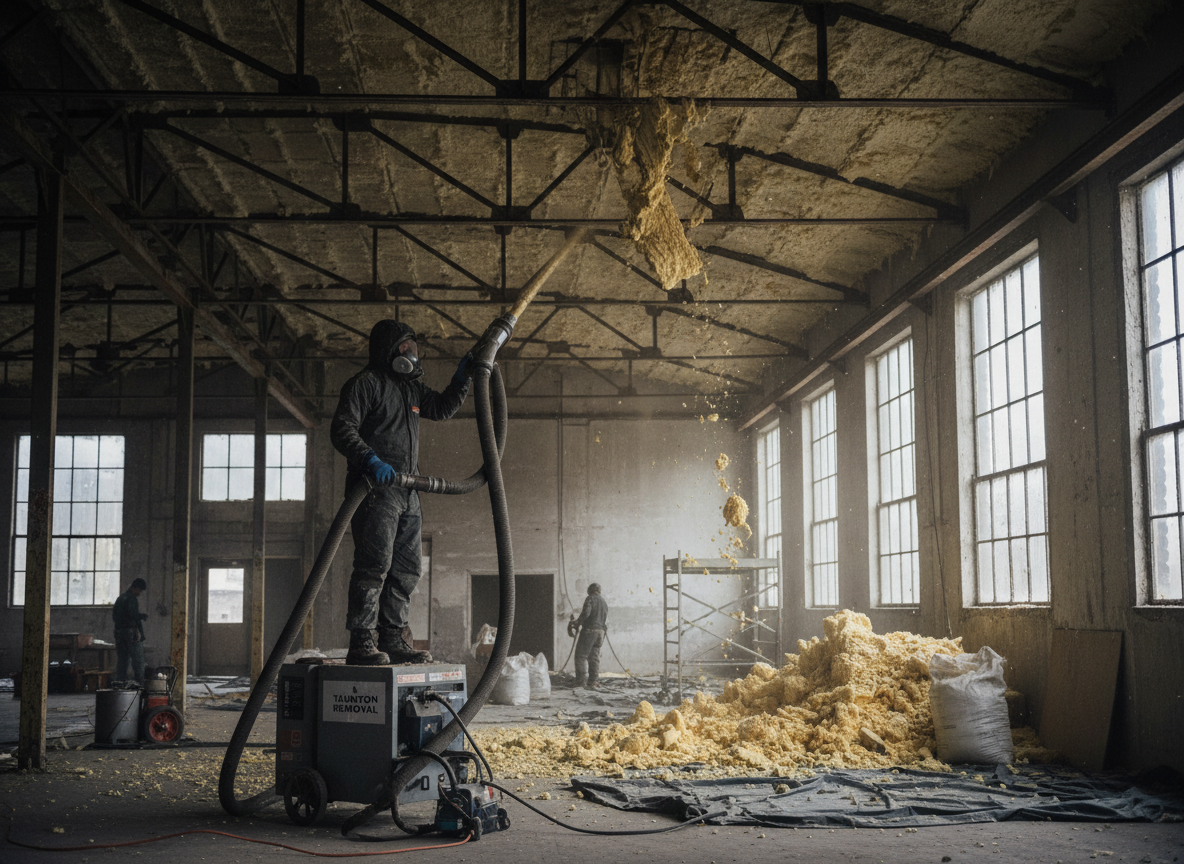
Commercial properties in Taunton often feature metal deck roofs and older suspended ceilings that trap moisture once spray foam is applied. In the Somerset climate, frequent rainfall drives water under the foam layer, leading to hidden corrosion on steel supports and degraded acoustic performance in open-plan spaces. Removal crews must isolate HVAC systems first to prevent foam particles from circulating through ductwork that serves multiple tenancies.
Edge cases appear regularly in Staplegrove and the industrial estates along the A38. Foam installed over existing mineral wool creates a double layer that releases isocyanates when cut, requiring negative-pressure enclosures and full-face respirators. Local building control expects waste to be segregated as hazardous if it contains fire-retardant additives common in 1990s commercial fit-outs.
Post-removal inspection focuses on thermal bridging at junctions with brick parapets, a detail that affects energy ratings for landlords renewing leases. Crews photograph every exposed fixing and joint before re-boarding so tenants have documented evidence for future maintenance.
Technician insight
In Taunton the thing that catches most people out with Commercial Spray Foam Removal is how Somerset rain drives water along the metal deck laps on units off Staplegrove Road, so the foam stays bonded even after the visible layer is gone and you have to chase the residue right into the joints.
Retail Unit On East Reach
A ground-floor shop unit near the bus station showed persistent condensation on stock shelving. Inspection revealed spray foam applied directly to the underside of a flat roof that had no vapour barrier. We isolated the extraction system, removed the foam in controlled strips and cleaned the steel purlins. The tenant reported stable humidity levels within two weeks and no further mould on cardboard packaging.
How it works
- 1
Site Survey And Containment Planning
Walk the commercial space to map foam thickness, identify load-bearing elements and set up dust barriers around occupied areas.
- 2
Mechanical Removal
Use low-speed scrapers and HEPA-filtered vacuums to lift foam from metal and concrete substrates while maintaining negative pressure.
- 3
Surface Cleaning And Waste Segregation
Neutralise residues, bag waste according to local disposal rules and clear all ductwork connected to the treated zone.
- 4
Final Verification
Carry out moisture checks and thermal imaging to confirm no foam remains before handing the space back to the tenant.
Pricing
Pricing depends on ceiling height, foam thickness and access restrictions; an on-site visit produces a fixed quote.