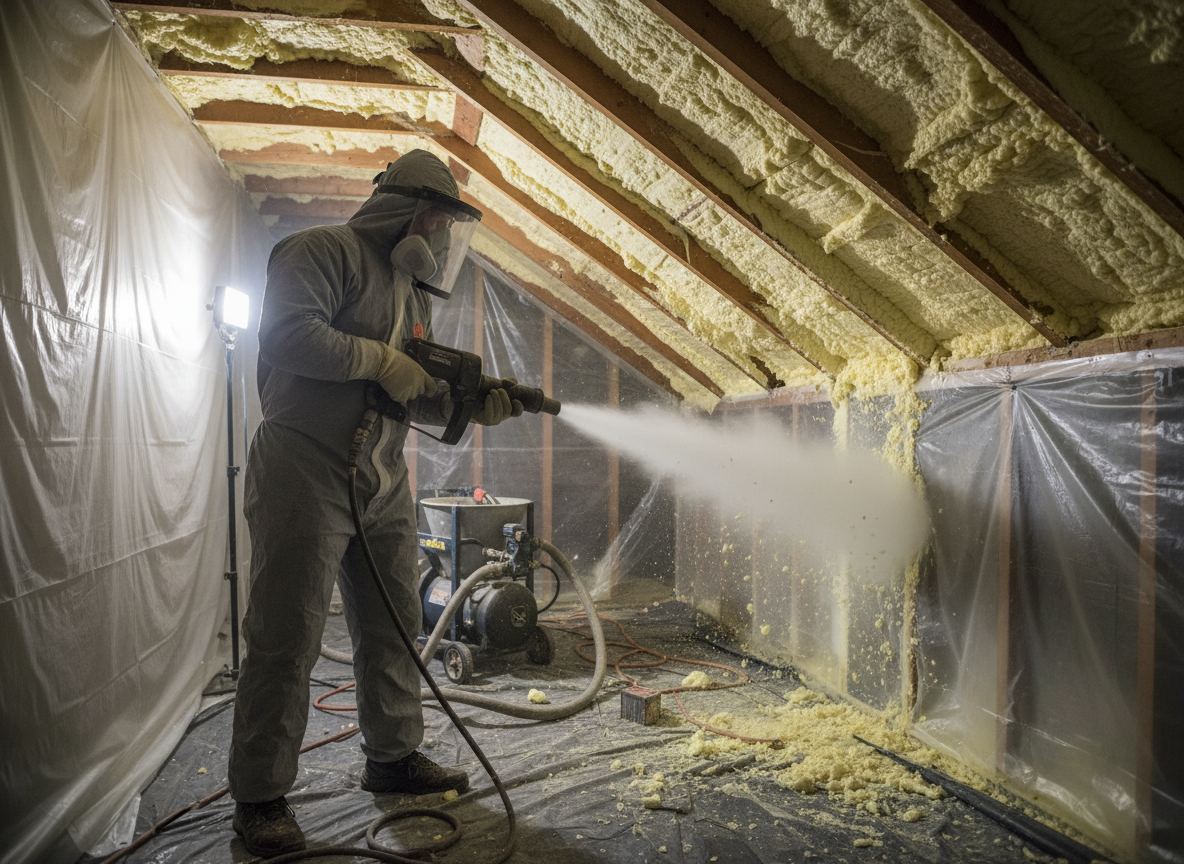
Dry ice blasting removes spray foam insulation without harsh chemicals or heavy scraping, which matters in Taunton's older terraced and semi-detached stock around Staplegrove and the town centre. Many of these homes, built before the 1950s, feature timber joists and lath ceilings that can be damaged by mechanical methods. The process uses solid CO2 pellets that sublimate on contact, lifting foam while leaving original surfaces intact even in damp Somerset conditions where moisture has already weakened adhesion.
Taunton's mild, wet winters often leave residual condensation behind failed foam, creating hidden mould pockets in lofts and cavity walls. Dry ice blasting reaches these areas without introducing additional water, unlike steam or solvent methods. Operators must control pellet velocity carefully on single-skin stone walls common near the river Tone to prevent surface pitting. Post-removal inspection typically reveals whether ventilation upgrades are needed to stop recurrence in the county's humid climate.
Edge cases include foam applied over electrical cabling or around chimney breasts in Edwardian properties. Blasting requires shielding live wires and staged passes to avoid thermal shock to flue linings. Debris is vacuumed continuously to keep dust levels low inside occupied homes, and all waste is bagged for licensed disposal rather than left on site.
Homeowners in Taunton sometimes attempt DIY scraping first, which leaves thin foam layers that then bond harder during later professional removal. Dry ice works best on intact applications; pre-damaged foam requires extra passes and longer setup times in confined roof spaces typical of local Victorian terraces.
Technician insight
In Taunton, the thing that catches most people out with dry ice blasting spray foam removal is the extra passes needed on homes near Staplegrove where decades of Somerset damp have made the foam bond tighter to the original rafters than the product data suggests.
Loft clearance in a central Taunton terrace
Owner reported persistent damp smells in an Edwardian terrace off the high street. Inspection showed spray foam trapping moisture against the ridge board. Dry ice blasting stripped the foam cleanly in two sessions. Joists dried out and new ridge ventilation was added to match local building patterns.
How it works
- 1
Site Assessment
Walk-through of attic or wall cavities to map foam depth, access points, and any hidden services in the Taunton property.
- 2
Protection Setup
Floor coverings, electrical isolation, and dust containment barriers installed before equipment enters the space.
- 3
Dry Ice Blasting
Pellets propelled at controlled pressure to lift foam from timber and masonry without abrasion.
- 4
Debris Removal and Final Check
Vacuum extraction of residue followed by visual inspection of joists and ventilation paths.
Pricing
Cost depends on foam thickness, access difficulty, and property size; site visit yields a clear written quote.