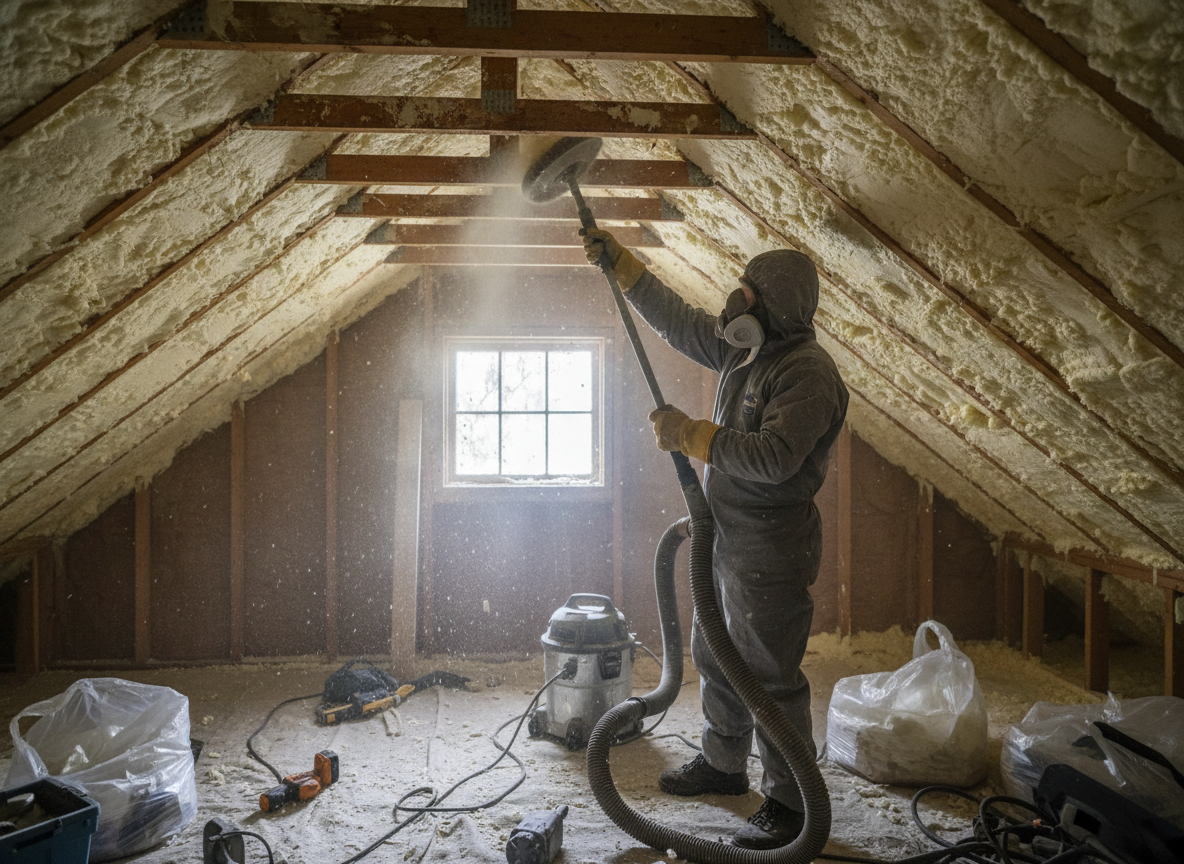
Open cell spray foam was widely installed in Taunton lofts during the 2000s and 2010s, particularly in Edwardian and Victorian terraces around Staplegrove and the town centre. Unlike closed cell, the open cell variety absorbs water readily, which is a recurring problem in Somerset's damp climate where winter rainfall often drives moisture into roof voids. Homeowners notice musty smells, reduced loft ventilation, and sometimes sagging insulation that no longer performs. Removal requires careful cutting and vacuum extraction to avoid damaging original lath and plaster ceilings below, especially in properties where the foam has bonded directly to rafters and joists.
Edge cases in the Taunton area include foam that has wicked water from leaking tiles on older slate roofs common around the Quantock fringes. Once saturated, the material becomes heavy and can pull away wiring or underfelt during extraction. Containment sheeting and negative air machines are essential to stop dust migrating into living spaces below, a frequent complaint when DIY attempts are made. Local building control sometimes requires notification if the work affects listed buildings or changes ventilation paths, so we always check the property age and construction before starting.
Disposal follows Environment Agency rules for construction waste; open cell foam cannot be left in domestic bins. We bag and remove it the same day, then restore ventilation with new soffit and ridge vents suited to the typical pitched roofs found in TA1 and TA2 postcodes. This prevents recurrence in the mild but persistently wet Somerset winters.
Technician insight
In Taunton, the thing that catches most people out with open cell spray foam removal is how the foam has soaked up years of Somerset rain through slipped tiles and then bonded tightly to the underside of rafters in 1920s semis around Staplegrove Road.
Loft clearance in a Staplegrove terrace
Homeowner reported persistent damp smell in a 1930s terrace near 100 Staplegrove Rd. We found open cell foam saturated along the north slope where tiles had slipped. Extraction revealed hidden rot on two rafter ends; we removed the foam, treated the timber, and restored ventilation before the next wet spell.
How it works
- 1
Site Assessment
Inspect loft access, foam depth, moisture levels, and any wiring or pipework in Taunton properties.
- 2
Containment Setup
Seal the work area with sheeting and run negative air filtration to protect the rest of the house.
- 3
Foam Extraction
Cut and vacuum the open cell material in sections, working around rafters without damaging original timber.
- 4
Cleanup and Ventilation Restoration
Remove all debris, clean surfaces, and fit new vents to restore airflow.
Pricing
Pricing depends on loft size, foam thickness, and access difficulty; we provide a clear quote after inspection.