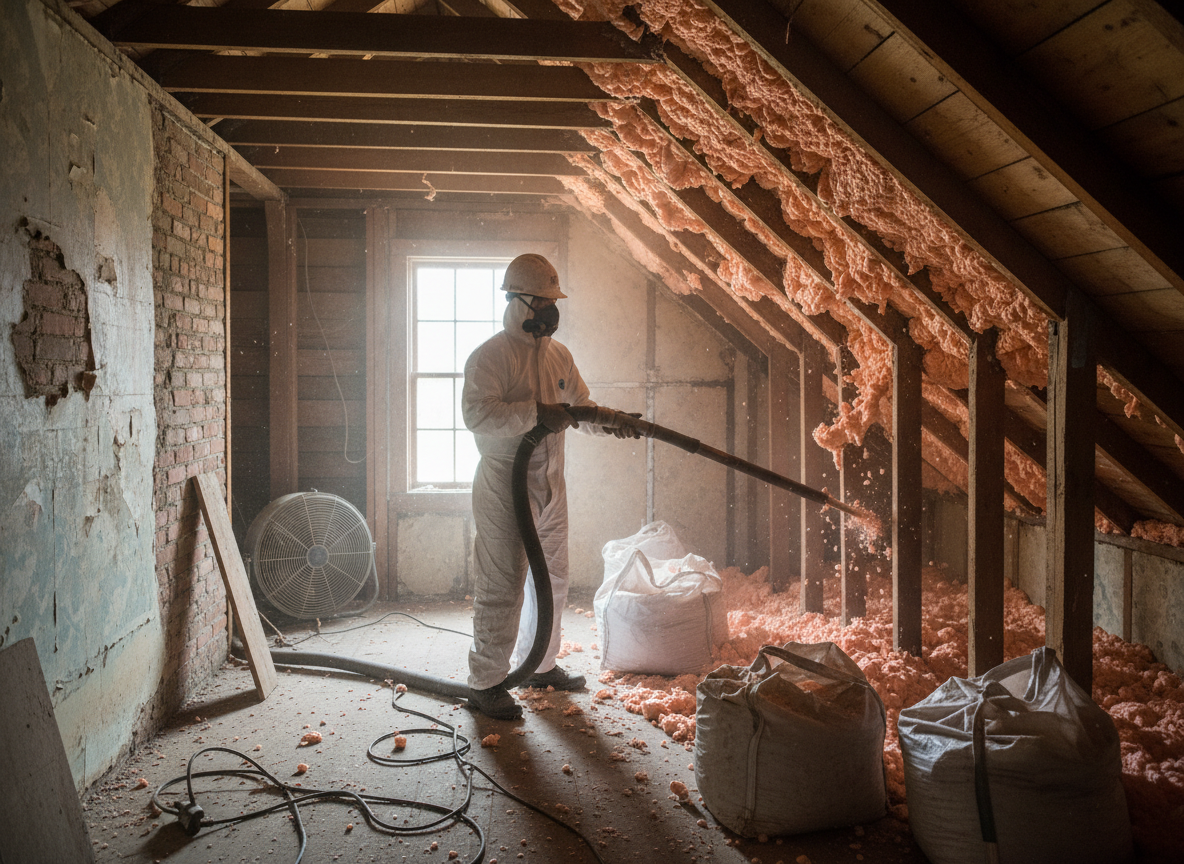
Thermal spray foam removal in Taunton often involves older Victorian and Edwardian terraces where closed-cell foam was injected into cavity walls or laid across lofts decades ago. Over time the material traps moisture against stone or brickwork, leading to timber decay and reduced breathability in properties that were never designed for impermeable insulation. Crews must cut the foam in sections while protecting original lath and plaster ceilings below, then bag and remove it without disturbing asbestos-containing materials common in Taunton’s pre-1960 housing stock.
Somerset’s frequent rainfall and mild winters accelerate problems when spray foam fails. Water sits against external walls for longer in the low-lying parts of Taunton near the River Tone, so extraction crews check for hidden damp before starting. Edge cases include foam that has bonded directly to electrical cabling or has expanded into chimney voids, requiring careful hand removal rather than mechanical methods to avoid structural damage.
Local building control in Taunton expects that once foam is stripped, the property returns to a ventilated state that meets current Part C and Part F requirements. Homeowners are advised to have a follow-up survey for condensation risk, especially in north-facing rooms where temperature differentials are greatest during the wetter months.
Common Materials Encountered
Closed-cell polyurethane and open-cell variants both appear in Taunton lofts; the former is denser and requires more time to section safely. Older installations sometimes contain HCFC blowing agents that need controlled disposal under current waste regulations.
Technician insight
In Taunton, the thing that catches most people out with thermal spray foam removal is how often the foam has wicked into the original lime mortar joints of 1890s terraces around Staplegrove and Wilton; once you start pulling it you discover the walls need time to dry before any new insulation goes back in.
Loft Foam Extraction in a Wilton Terrace
Homeowner noticed black mould along the eaves of a 1920s Taunton terrace after heavy winter rain. Inspection found closed-cell foam bonded to rafters and trapping moisture against the slate roof. We sectioned the foam by hand, cleared it through the rear dormer, and left the loft ventilated; mould risk dropped once airflow returned.
How it works
- 1
Site Assessment
Inspect loft or wall cavities, note original construction type, and identify any electrical or plumbing runs embedded in the foam.
- 2
Containment Setup
Seal off living areas with plastic sheeting and negative air units to prevent dust migration into Taunton homes.
- 3
Section and Remove
Cut foam into manageable pieces, bag on site, and carry out through external access points where possible.
- 4
Clearance and Ventilation Check
Remove all residue, inspect for remaining damp, and advise on restoring natural airflow.
Pricing
Pricing depends on property age, foam depth, and access difficulty; site visit required for accurate quote.